Blog as MVP: How to Start Before You’re Ready
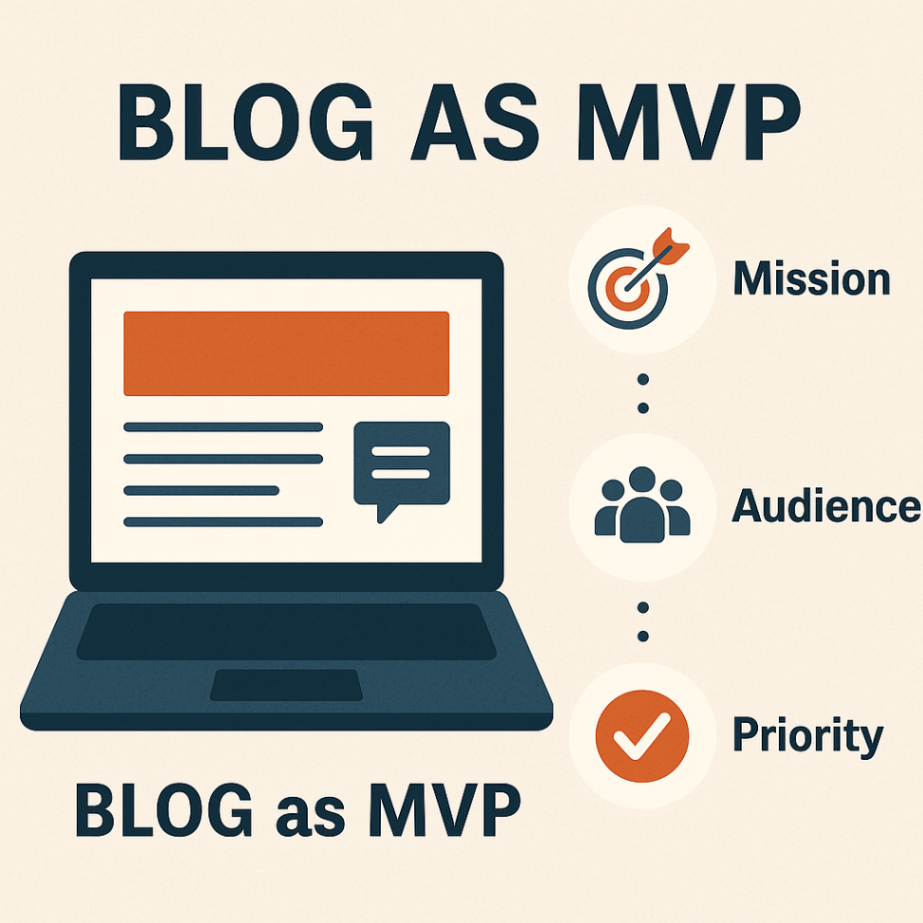
TL;DR In product design, an MVP (Minimum Viable Product) is the smallest version of an idea that still solves a real problem. This concept from Coursera’s Fast Prototyping of GenAI Apps with Streamlit teaches that building smaller and faster helps you learn quicker through feedback.
To define your MVP, you can use MAP — Mission, Audience, and Priority:
- Mission: What problem are you solving, and what’s your goal?
- Audience: Who are you helping?
- Priority: What’s the smallest, most important thing you can do first?
This blog post is my Minimum Viable Post — a working prototype of learning in public. If you’ve ever overthought before publishing, this post gives you a way to start small, solve that hesitation, and build your own feedback loop.
Blog as MVP: How to Start Before You’re Ready
Before you build anything — a product, a dashboard, or even a blog — you need to decide what to build first. The Coursera course Fast Prototyping of Generative AI Apps with Streamlit puts it simply:
“The answer is not the whole thing, just the minimum viable product — the smallest version of your idea that still solves a real problem.”
Most creators (and AI developers) overbuild, overthink, and burn out. The course emphasizes that an MVP helps you build smarter, not harder — by learning quickly, not by perfecting. It’s a mindset that applies beautifully to writing and learning, too.
🎯 What an MVP Means for Writing
For an app, an MVP is a single working feature that solves one pain point. For a blog, an MVP is a single post that:
- Addresses one real frustration (like fear of starting),
- Offers a small but useful perspective,
- Invites feedback for the next iteration.
You’re not aiming for perfection — just a viable first version that delivers value and creates a feedback loop.
Think of it as:
Plan → Write → Publish → Learn → Improve → Repeat.
It’s better to publish one short, testable post ten times and learn from readers than to spend ten weeks polishing one post that never sees daylight.
💡 Applying MAP to Define This MVP
The Coursera course also introduces MAP — Mission, Audience, and Priority — a simple way to scope your MVP. Here’s how it translates to blogging:
| Element | Meaning | Applied to this Post |
|---|---|---|
| Mission | What’s your end goal? | Help readers (and myself) start sharing before they feel ready. |
| Audience | Who is it for? | DATA Saber challengers, Tableau & data learners, and anyone stuck overthinking their writing. |
| Priority | What’s essential right now? | Publish one useful post that helps someone start — no overpolish, no extras. |
👥 The Problem We’re Solving
The real issue:
“I want to share what I’m learning, but I don’t know where to start — it’s not ready yet.”
This hesitation keeps us from publishing. By treating the blog as an MVP, we create permission to start small — to build a minimal, working version of our idea that helps one person (maybe even ourselves).
📈 What “Viable” Means for a Blog
A blog post becomes viable when it actually helps solve a small problem, even slightly. That means:
- ✅ The post gives readers a tool, mindset, or clarity they can use today.
- 💬 It sparks at least one genuine conversation or reflection.
- 🧠 It provides a learning signal — what resonated, what didn’t — to shape the next post.
Viability isn’t measured by likes or traffic — it’s measured by learning and usefulness.
🧭 My MAP for This Series
- Mission: Practice applying MVP thinking to blogging and visualization.
- Audience: DATA Saber and Tableau community members who value iteration over perfection.
- Priority: Publish early, learn fast, and let feedback drive the next post.
This isn’t a finished product; it’s the first working version of an ongoing conversation.
🔭 What Comes Next
In future posts, I’ll explore how this MVP mindset translates into visualization — how to prototype dashboards with the same “start small, test early” approach. But for now, the goal is simple:
Build your own Minimum Viable Post. Define your Mission, Audience, and Priority — and publish something small today.
You’ll learn more from one real post than from ten unfinished drafts.
🗣️ Join the Conversation
If you try your own Minimal Viable Post, share it with #BlogAsMVP #DATASaber. Let’s treat writing as a product — shipped, tested, and improved together.